 COME CORRECT!
Monday, November 12, 2007

Sunday, November 04, 2007
Science Infinite...thank you...
Damn, I was just talking about support within the community to sustain its values...and then I got to see this...
Thursday, November 01, 2007
What if? I Wouldn't Put it Past Profiteers...
I never saw this at the time, but this was a terrifying hoax article in 2003...Imagining what if?
WHO REALLY OWNS HIP HOP?
USE THE TERM 'HIP HOP' & PAY A LICENSING FEE
by Davey D from (www.daveyd.com)
It looks like the Hip Hop community now faces its biggest challenge.
Forget police task forces or discriminating night club owners, folks
will now have to gear up to do some serious battle with a Los Angeles
businessman named Richard Gonahangya and his company America Media
Operative Inc. For those who don't know AMO Inc is a little known
company that specializes in lobbying Congress and advising government
officials on media policy. They yield a lot of influence over the FCC
and other agencies that determine policy. The word around town is
'what they say goes'.
Gonahangya a staunch conservative, held a small press conference in
Compton, Ca yesterday to announce that his company AMO Inc had
recently trademarked and brought the rights to the word/phrase 'Hip
Hop'. As a result they will soon start charging a licensing fee for
anyone who wishes to use the word in a commercial/ for profit project.
Taking advantage of a provision in the recently amended Millennium
Copyright Act of 2001, Gonahangya explained that he and his company
have all the legal ammunition and clearance to own the rights to the
phrase 'Hip Hop'. He noted that the Hip Hop industry has generated
over 20 billion dollars last year in the United States alone. The
phrase Hip Hop is now a powerful marketing tool and his company is
posed to profit handsomely in 2003 from its 'proper' usage. The new
licensing fee is estimated to net AMO Inc a whooping 5-8 billion
dollars a year.
"Any business including record labels, videos, radio stations or
television shows that use the phrase 'Hip Hop' in the title or
marketing body of their work will have to pay AMO Inc a licensing
fee", Gonahangya told reporters. 'We are not attempting to stifle
free speech or muzzle popular culture.. we have no legal grounds from
preventing anyone who wishes to use the word in everyday speech,
however if you are using the word in a manner that associates you with
a salable product, then we fully intend to collect our fee".
Gonahangya went on to explain that what he is doing is not unusual.
There are many popular words that are used in everyday conversations
that are trademarked and cannot be used in commercial ventures without
permission. 'The word 'Xerox' is often used interchangeably with
'copy'. The word 'Vaseline' is used interchangeably with lotion or
grease. he also explained that the word Rock-N-Roll is trademarked by
a major label record executive who at the time could not charge a
licensing fee.
Gonahangya laid out his company's strategy for 2003. He explained
that AMO Inc is giving record labels and performers a one month grace
period to get their business affairs in order. Starting in May
letters will be sent out to anyone who is using the term 'Hip Hop'
explaining that the word is now trademarked and that if they wish to
continue to use it in the body of their work, they will have to
register with his company and be assessed a licensing fee. Letters
have already been sent to several Hip Hop internet websites with more
to come. He estimated the average fee will be anywhere from 2-5
thousand dollars plus residual fees per project. Permission to use
the word will be on a case by case basis. In addition any future
projects released using the term ' Hip Hop' will have to have the 'TM'
symbol next to the word.
When asked if he felt AMO Inc was being exploitative and attempting to
blackmail a viable popular culture, Gonahangya bluntly stated; 'This
is not about culture. This is about business... The laws have been
set up for anyone and everyone to use. Our company took advantage of
what was on the books for almost a year and that what we are doing is
now perfectly legal... Hip Hop is a big multi-billion dollar a year
business. I was surprised that a big executive like Russell Simmons
or Clive Davis or even business savy rappers like Jay-Z, P-Diddy or
Eminem never trademarked the phrase. Everyone in America knows that
you don't do business without protecting your assets. It's just plain
stupid not to leave yourself this wide open.. If the Hip Hop
community is that dumb when it comes to business then too bad. Don't
make me out to be the bad guy".
When asked if he intends to share any of the profits from licensing
the word 'Hip Hop' with any of Hip Hop's pioneers including Lovebug
Starski who first coined the phrase back in the lates 70s or Afrika
Bambaataa who popularized and spread the word, Gonahangya laughed. 'I
never heard of a Mr Starski and as for sharing profits with people
from Africa..No my people are originally from Denmark, Norway.
When another reporter told Gonahangya that Afrika Bambaataa was
someone's name, Gonahangya shrugged it off and said he had no
intentions of sharing the profits with anyone but his company and his
family." However, he did offer a discounted licensing fee for Starski
and Bambaataa since they coined and helped popularized the term.
When asked if there would be any sort of criteria set up to determine
who will and will not be allowed to use the phrase 'Hip Hop',
Gonahangya explained that for most part if a company has the money and
a viable revenue stream for residual payments then it should be a
'piece of cake'. As for criteria, Gonahangya explained that he has
very little tolerance and respect for individuals and companies that
are attempting to use the phrase Hip Hop for political gain.
"Recently the term 'Hip Hop' has been positioned as a
progressive/liberal movement. That's unfair and a totally one-sided
approach to what is an American institution.Hip Hop is for everyone.
It is not a slick political campaign tool for Jesse Jackson, Al
Sharpton or Hillary Clinton.", he retorted
Gonahangya became evasive when asked if he would allow the term Hip
Hop to be used by any of the conservative organizations that he
regularly associates with and lobbies for. " To be honest we have not
ruled them out. We believe that Hip Hop needs to be politically
balanced. For years Hip Hop has been associated with liberal causes
that have totally undermined the moral fiber of this country. We will
be very selective as to how Hip Hop will be used politically", he said
Gonahangya continued; "I will assure you this... In the future you
will not be seeing billboards or magazine ads with the words 'Hip Hop'
and Reparations, 'Hip Hop' and Affirmative Action or even 'Hip Hop'
and Black Power anytime soon. If it hasn't come through our offices
and been granted a licensing fee then its existence will be in
violation of the Millennium Copyright Act of 2001 and we intend to
aggressively go after any violators and prosecute. This about
political integrity and money".
Some our speculating that Gonahangya intends to use his ownership of
the now trademarked term 'Hip Hop' to quiet down any sort of political
movement that has been organizing around the term in time for the 2004
elections.
We caught up with Greg Watkins webmaster of the popular site
allhiphop.com and he noted that he had received a letter from
Gonahangya's AMO Inc company earlier this month. "He told us in the
letter that we were in violation of his this trademark law and that me
and my partner Chuck would have to pay licensing fee if we wanted to
keep the word 'Hip Hop in our name. We checked with our lawyers and
found out that we were safe because we are allhiphop and not just 'hip
hop'. It's obvious these guys are serious about collecting their
money".
We caught up with long time Bay Area writer and Hip Hop deejay Billy
Jam who does the Hip Hop Slam radio show and has the website Hip Hop
Slam. "Yeah this attorney contacted my attorney and said I would have
to take the 'Hip Hop' out of Hip Hop Slam or pay a fee if I want to
continue doing business. At first I thought it was a joke and then
days later I received a subpoena to show up in court. I was told if I
don't remove the word Hip Hop from Hip Hop Slam or pay a licensing fee
then I could lose my house, my car and my prized record collection".
Normally I don't give a damn about such things, but I can't afford to
lose my records", Billy Jam said
We caught up with popular Bay Area rapper /writer JR The Rap Slanger
out of East Oakland. He said: " Look man, this country's always been
about business and fools is gonna try and collect their paper. But
this is straight up bullS%$T. How's this fool gonna try and trademark
a word and collect a fee? Brothas need to rise up and retaliate and
put a foot in his ass. But let's be honest, me personally I don't
have to worry because I'm not really Hip Hop. I rap. I'm a rapper.
There's a difference between rap and Hip Hop. I guess Hip Hop is
gonna die but rap is gonna go on forever! He didn't trademark the
word Rap did he? "
As far as I can tell the word rap is not trademarked. Nor can it be
because of it's long standing everyday usage.
We checked with famed NY copyright attorney Arnold Esquire Sullivan
and he soberly explained that the new provisions that have been added
does indeed give AMO Inc the right to trademark and collect a
licensing fee for use of the word Hip Hop and any other coined
'unique' phrase. If the word is made up or unique to the American
lexicon then it can be trademarked and people will have to pay a fee
if they wish to use it in any sort of business endeavor.
Sullivan explained the new amendment went through around the same time
they were crafting the Patriot Act. "It's a shame people went to
sleep on this. I hate to say this but Negroes had better wake up and
start smelling the coffee. These people in Washington are not
playing".
Sullivan concluded by noting that failure to comply with the new
trademark laws can result in serious economic repercussions and a
stiff 5 year prison sentence. He noted that the stiff prison sentence
came after music industry executives and software companies lobbied
congress for harsher penalties for bootleggers and other 'copyright'
thieves'. "Unfortunately this new trademark law as it pertains to the
phrase Hip Hop can potentially land people in jail if they try to make
a profit off it', Sullivan noted.
At the end of the press conference Gonahangya explained that he is
currently in negotiations with a major broadcast company so that they
will have the exclusive rights to the word 'Hip Hop'. Gonahangya
declined to name the outlet that he is dealing with, but he did note
that should everything work out according to plan this media outlet
has vast resources and will set up offices throughout the country and
help determine which projects and products will be allowed to use the
term 'Hip Hop'. Gonahangya refused to say whether or not it would be
an outlet like Clear Channel, Viacom or Emmis that would be
determining who can or cannot use the word 'Hip Hop'. "It would be
premature for me to give out that information", he said
It is clear that big corporations and government lobbyist now own Hip
Hop.
Gonahangya also reiterated the fact that he is extending a month long
grace period. He also used the occasion to pitch his new licensing
service. In what appeared to be a real cheesy move he stated that he
was offering a one time discount for the next two weeks. He explained
that he understands that there are a lot of non-profits that use the
phrase Hip Hop in literature and other marketing schemes and as a
result they will be granted a one time 500 dollar processing fee and
will subjected to the similar constraints of their 501 non profit
status. That means they can not use Hip Hop as a political marketing
arm.
Non political Independent record labels and artist can obtain a
lifetime license to use the word Hip Hop for 500 dollars. Gonahangya
explained that he believes in doing things for the community and this
is his way of giving back.
"Let it not be said I don't care for the underdog", he said. AMO Inc
is all about helping the downtrodden. We normally charge on average
of 5000 thousand plus lifetime residual fees, but because we care
about the little people we will offer Hip Hop [TM] for 500 dollars
licensing fee for the next two weeks.
If anyone wishes to fill out an application to see if you qualify to
use the term 'Hip Hop' in your product or if you want more information
on AMO Inc call them at 1-800-233-4563
WHO REALLY OWNS HIP HOP?
USE THE TERM 'HIP HOP' & PAY A LICENSING FEE
by Davey D from (www.daveyd.com)
It looks like the Hip Hop community now faces its biggest challenge.
Forget police task forces or discriminating night club owners, folks
will now have to gear up to do some serious battle with a Los Angeles
businessman named Richard Gonahangya and his company America Media
Operative Inc. For those who don't know AMO Inc is a little known
company that specializes in lobbying Congress and advising government
officials on media policy. They yield a lot of influence over the FCC
and other agencies that determine policy. The word around town is
'what they say goes'.
Gonahangya a staunch conservative, held a small press conference in
Compton, Ca yesterday to announce that his company AMO Inc had
recently trademarked and brought the rights to the word/phrase 'Hip
Hop'. As a result they will soon start charging a licensing fee for
anyone who wishes to use the word in a commercial/ for profit project.
Taking advantage of a provision in the recently amended Millennium
Copyright Act of 2001, Gonahangya explained that he and his company
have all the legal ammunition and clearance to own the rights to the
phrase 'Hip Hop'. He noted that the Hip Hop industry has generated
over 20 billion dollars last year in the United States alone. The
phrase Hip Hop is now a powerful marketing tool and his company is
posed to profit handsomely in 2003 from its 'proper' usage. The new
licensing fee is estimated to net AMO Inc a whooping 5-8 billion
dollars a year.
"Any business including record labels, videos, radio stations or
television shows that use the phrase 'Hip Hop' in the title or
marketing body of their work will have to pay AMO Inc a licensing
fee", Gonahangya told reporters. 'We are not attempting to stifle
free speech or muzzle popular culture.. we have no legal grounds from
preventing anyone who wishes to use the word in everyday speech,
however if you are using the word in a manner that associates you with
a salable product, then we fully intend to collect our fee".
Gonahangya went on to explain that what he is doing is not unusual.
There are many popular words that are used in everyday conversations
that are trademarked and cannot be used in commercial ventures without
permission. 'The word 'Xerox' is often used interchangeably with
'copy'. The word 'Vaseline' is used interchangeably with lotion or
grease. he also explained that the word Rock-N-Roll is trademarked by
a major label record executive who at the time could not charge a
licensing fee.
Gonahangya laid out his company's strategy for 2003. He explained
that AMO Inc is giving record labels and performers a one month grace
period to get their business affairs in order. Starting in May
letters will be sent out to anyone who is using the term 'Hip Hop'
explaining that the word is now trademarked and that if they wish to
continue to use it in the body of their work, they will have to
register with his company and be assessed a licensing fee. Letters
have already been sent to several Hip Hop internet websites with more
to come. He estimated the average fee will be anywhere from 2-5
thousand dollars plus residual fees per project. Permission to use
the word will be on a case by case basis. In addition any future
projects released using the term ' Hip Hop' will have to have the 'TM'
symbol next to the word.
When asked if he felt AMO Inc was being exploitative and attempting to
blackmail a viable popular culture, Gonahangya bluntly stated; 'This
is not about culture. This is about business... The laws have been
set up for anyone and everyone to use. Our company took advantage of
what was on the books for almost a year and that what we are doing is
now perfectly legal... Hip Hop is a big multi-billion dollar a year
business. I was surprised that a big executive like Russell Simmons
or Clive Davis or even business savy rappers like Jay-Z, P-Diddy or
Eminem never trademarked the phrase. Everyone in America knows that
you don't do business without protecting your assets. It's just plain
stupid not to leave yourself this wide open.. If the Hip Hop
community is that dumb when it comes to business then too bad. Don't
make me out to be the bad guy".
When asked if he intends to share any of the profits from licensing
the word 'Hip Hop' with any of Hip Hop's pioneers including Lovebug
Starski who first coined the phrase back in the lates 70s or Afrika
Bambaataa who popularized and spread the word, Gonahangya laughed. 'I
never heard of a Mr Starski and as for sharing profits with people
from Africa..No my people are originally from Denmark, Norway.
When another reporter told Gonahangya that Afrika Bambaataa was
someone's name, Gonahangya shrugged it off and said he had no
intentions of sharing the profits with anyone but his company and his
family." However, he did offer a discounted licensing fee for Starski
and Bambaataa since they coined and helped popularized the term.
When asked if there would be any sort of criteria set up to determine
who will and will not be allowed to use the phrase 'Hip Hop',
Gonahangya explained that for most part if a company has the money and
a viable revenue stream for residual payments then it should be a
'piece of cake'. As for criteria, Gonahangya explained that he has
very little tolerance and respect for individuals and companies that
are attempting to use the phrase Hip Hop for political gain.
"Recently the term 'Hip Hop' has been positioned as a
progressive/liberal movement. That's unfair and a totally one-sided
approach to what is an American institution.Hip Hop is for everyone.
It is not a slick political campaign tool for Jesse Jackson, Al
Sharpton or Hillary Clinton.", he retorted
Gonahangya became evasive when asked if he would allow the term Hip
Hop to be used by any of the conservative organizations that he
regularly associates with and lobbies for. " To be honest we have not
ruled them out. We believe that Hip Hop needs to be politically
balanced. For years Hip Hop has been associated with liberal causes
that have totally undermined the moral fiber of this country. We will
be very selective as to how Hip Hop will be used politically", he said
Gonahangya continued; "I will assure you this... In the future you
will not be seeing billboards or magazine ads with the words 'Hip Hop'
and Reparations, 'Hip Hop' and Affirmative Action or even 'Hip Hop'
and Black Power anytime soon. If it hasn't come through our offices
and been granted a licensing fee then its existence will be in
violation of the Millennium Copyright Act of 2001 and we intend to
aggressively go after any violators and prosecute. This about
political integrity and money".
Some our speculating that Gonahangya intends to use his ownership of
the now trademarked term 'Hip Hop' to quiet down any sort of political
movement that has been organizing around the term in time for the 2004
elections.
We caught up with Greg Watkins webmaster of the popular site
allhiphop.com and he noted that he had received a letter from
Gonahangya's AMO Inc company earlier this month. "He told us in the
letter that we were in violation of his this trademark law and that me
and my partner Chuck would have to pay licensing fee if we wanted to
keep the word 'Hip Hop in our name. We checked with our lawyers and
found out that we were safe because we are allhiphop and not just 'hip
hop'. It's obvious these guys are serious about collecting their
money".
We caught up with long time Bay Area writer and Hip Hop deejay Billy
Jam who does the Hip Hop Slam radio show and has the website Hip Hop
Slam. "Yeah this attorney contacted my attorney and said I would have
to take the 'Hip Hop' out of Hip Hop Slam or pay a fee if I want to
continue doing business. At first I thought it was a joke and then
days later I received a subpoena to show up in court. I was told if I
don't remove the word Hip Hop from Hip Hop Slam or pay a licensing fee
then I could lose my house, my car and my prized record collection".
Normally I don't give a damn about such things, but I can't afford to
lose my records", Billy Jam said
We caught up with popular Bay Area rapper /writer JR The Rap Slanger
out of East Oakland. He said: " Look man, this country's always been
about business and fools is gonna try and collect their paper. But
this is straight up bullS%$T. How's this fool gonna try and trademark
a word and collect a fee? Brothas need to rise up and retaliate and
put a foot in his ass. But let's be honest, me personally I don't
have to worry because I'm not really Hip Hop. I rap. I'm a rapper.
There's a difference between rap and Hip Hop. I guess Hip Hop is
gonna die but rap is gonna go on forever! He didn't trademark the
word Rap did he? "
As far as I can tell the word rap is not trademarked. Nor can it be
because of it's long standing everyday usage.
We checked with famed NY copyright attorney Arnold Esquire Sullivan
and he soberly explained that the new provisions that have been added
does indeed give AMO Inc the right to trademark and collect a
licensing fee for use of the word Hip Hop and any other coined
'unique' phrase. If the word is made up or unique to the American
lexicon then it can be trademarked and people will have to pay a fee
if they wish to use it in any sort of business endeavor.
Sullivan explained the new amendment went through around the same time
they were crafting the Patriot Act. "It's a shame people went to
sleep on this. I hate to say this but Negroes had better wake up and
start smelling the coffee. These people in Washington are not
playing".
Sullivan concluded by noting that failure to comply with the new
trademark laws can result in serious economic repercussions and a
stiff 5 year prison sentence. He noted that the stiff prison sentence
came after music industry executives and software companies lobbied
congress for harsher penalties for bootleggers and other 'copyright'
thieves'. "Unfortunately this new trademark law as it pertains to the
phrase Hip Hop can potentially land people in jail if they try to make
a profit off it', Sullivan noted.
At the end of the press conference Gonahangya explained that he is
currently in negotiations with a major broadcast company so that they
will have the exclusive rights to the word 'Hip Hop'. Gonahangya
declined to name the outlet that he is dealing with, but he did note
that should everything work out according to plan this media outlet
has vast resources and will set up offices throughout the country and
help determine which projects and products will be allowed to use the
term 'Hip Hop'. Gonahangya refused to say whether or not it would be
an outlet like Clear Channel, Viacom or Emmis that would be
determining who can or cannot use the word 'Hip Hop'. "It would be
premature for me to give out that information", he said
It is clear that big corporations and government lobbyist now own Hip
Hop.
Gonahangya also reiterated the fact that he is extending a month long
grace period. He also used the occasion to pitch his new licensing
service. In what appeared to be a real cheesy move he stated that he
was offering a one time discount for the next two weeks. He explained
that he understands that there are a lot of non-profits that use the
phrase Hip Hop in literature and other marketing schemes and as a
result they will be granted a one time 500 dollar processing fee and
will subjected to the similar constraints of their 501 non profit
status. That means they can not use Hip Hop as a political marketing
arm.
Non political Independent record labels and artist can obtain a
lifetime license to use the word Hip Hop for 500 dollars. Gonahangya
explained that he believes in doing things for the community and this
is his way of giving back.
"Let it not be said I don't care for the underdog", he said. AMO Inc
is all about helping the downtrodden. We normally charge on average
of 5000 thousand plus lifetime residual fees, but because we care
about the little people we will offer Hip Hop [TM] for 500 dollars
licensing fee for the next two weeks.
If anyone wishes to fill out an application to see if you qualify to
use the term 'Hip Hop' in your product or if you want more information
on AMO Inc call them at 1-800-233-4563
Wednesday, October 31, 2007
Zero Chemistry = Anthropology/Archaeology...also a review of "The Run Up", a good reason to go to school...
So yeah, I feel a bit lame in that I am fickle, after becoming uninspired from feeling overwhelming pressure to retain the specificities that separate the professional from the enthusiastic hobbyist, but also a lot relieved...I changed my major today, talked to the Deputy Head of the Anthropology Department, and this sudden change of heart occurred all after only seven weeks as a student Chemist...Ideally I would've liked to have been an Environmental Chemist, maybe in an alternate universe, but I broke it to my Mom that, "I ain't that smart..." I mean, all my other requirements would be finished by next year and what would be left would be all the purely Physical Sciences...Man, I think I'd have a nervous breakdown if I did that to myself...I mean, all Advanced Chem, Biology AND Physics at the same time...It really burst her bubble, I think, but underneath it all, I think she knew it was all wrong for me, the Mathematician or the Chemist outfits I was trying on...Perhaps if I was at a different point in my life, I mean younger and less tired of the retention of just straight facts with no real sparks of interest flying around and proving of mathematical theorems, not so distracted by other interests...but I also don't think I'm the type to be cooped up in a sterile environment wearing a lab coat and goggles, oh especially the goggles, mixing things using fire and other types of possibly dangerous solutions...And when I would come home from class, I would just complain to C about what happened in Chem class that day, really distressed because I was put off by it...The one class I have come home talking his ear off about is the one involving social theory, injustices and cultural/global/governmental issues...Plus naturally with the experiences that I have accumulated through graff and the art world and just living in this world, I am a sponge for research and query, one thing I learned from my experience in graff is getting a feel for knowing who to believe when you filter through the history information, sift through what a broad range of people say, not taking everything as facts until you know it to be the reality, taking sources with a grain of salt...finding firsthand sources, citing them properly...Like tonight Greg and I watched "The Run Up"...Mr. Cartoon (though his style of art is not really a favorite style of mine, I respect him for his work 'cuz he's damn good at what he does)...made everyone else look like clowns in the movie 'cuz he came with wisdom, not a bunch of commercials posing as documentary footage and he had the skills of someone who stuck with something he loved even though life was happening around him, but that maybe also saved him, didn't turn him into some phoney masturbating into the camera blowing himself up so much or as Greg put it, "talking that art space bullsh*t"...In most of the segments, the up-close with the artist, who in most cases and them speaking...wow, it really ruined their art for me in most cases...Made me glad that I wasn't in the position that I was behind a camera yakking away unnecessarily and/or showing work that kinda was lacking ...Yeah, I really wouldn't want to be an "art star"...Watching that movie was like seeing the awful ugly-hearted man pulling all these strings and pulleys behind the big curtain of artwork with all the special effects...Destroys the whole fantasy...There were a couple of exceptions. The two English guys, Mr. Jago & Will Barras, creating the Design Agency in response to a book they had previously put out, now that would be pretty cool to do an animated spot on Nickelodeon and of course the legendary Bodes (Vaughan and Mark)...I think the artists interviewed outside the US had more of a grip on reality, not tripped up by that problem with ego or that need to demand confirmation that they are famous...Famous is all a matter of to who? Making a living by doing art is not the issue. I spent a sleepless night after watching the 2 set disc...and found that there's two kinds of people...the kind who's seen too much to talk, who if you don't come correct to, don't step on their block 'cuz they won't waste their time, or the gotta-get-over-on-everyone 'cuz real life hasn't slapped them in the face...hopefully yet...and they talk and play the victims and have ulterior motives, trying to be deep when they only seem to drown themselves in their fluff...with amazing rubber jaws so they can exhibit their incredible abilities to suck their own _________...
Viva la Elocution! YA!
Yeah, the course list sounds like fun...Indiana Jones dreams, I suppose...But what's wrong with that?...I remember at MassArt I took a class called Glories of Ancient Greece...The teacher was a career changer, decided late in life to go back to school to study Archaeology; she had a lot of experience with history and culture because she had been on digs in Greece...I thought that was the coolest thing I'd ever heard and she seemed really happy about it, I think she even said it was the best decision she'd ever made...Anyways, I don't want to cry wolf about my major...I feel like there's a lot of people invested in the eventual outcome of this whole going back to school again thing but then again, how are you going to find out something doesn't fit unless you try it on?
Viva la Elocution! YA!
Yeah, the course list sounds like fun...Indiana Jones dreams, I suppose...But what's wrong with that?...I remember at MassArt I took a class called Glories of Ancient Greece...The teacher was a career changer, decided late in life to go back to school to study Archaeology; she had a lot of experience with history and culture because she had been on digs in Greece...I thought that was the coolest thing I'd ever heard and she seemed really happy about it, I think she even said it was the best decision she'd ever made...Anyways, I don't want to cry wolf about my major...I feel like there's a lot of people invested in the eventual outcome of this whole going back to school again thing but then again, how are you going to find out something doesn't fit unless you try it on?
Tuesday, October 23, 2007
Mac Quest for More Hard Drive Space...
On my quest for more space (less is more), I realized that my music collection was really becoming too large for its own good and that I had to do something about it...iTunes will allow you to create a new library on an external hard drive and completely remove the music from your internal one. Except for the games...Keep the files for them and add them to your library later. This article titled "Can I Move the Contents of all my Family Members' iTunes Libraries to an External Drive so We can All use the same Library?" goes through the step-by-step process in detail. And you do have to resync your iPod to the new external hard drive's library if you want to be able to edit your iPod...Man, I freed up about 50 GB though...It's like a brand new computer with all the space...
Monday, October 22, 2007
Fonts, Fonts, and Tiger OSX and Corruption...
Okay, for all of you who are font-greedy and need some advice on what to do when you installed a bunch of fonts and your computer gives you unpleasant font error messages (Microsoft Word esp.) like please remove corrupt font files...I was lucky enough to come across Corrupt Font Errors in Word 2004/OS X 10.4.x (Tiger) for what to do with the whole mess...There's two great apps, the first is free and is called Linotype FontExplorer X and the second one called Font Doctor (the link in the article doesn't actually work, but this softpedia link does) actually fixes the corrupt fonts but it costs $69.99. The demo version WILL diagnose the corrupt fonts, though...After messing with my FontBook app for hours and realizing that it is really not that much of a help, is slow, and takes up so much of the processor power that I barely made any progress, well these two apps helped me out a lot...
Monday, October 15, 2007
Animated Internet celebs homage and Wierd Al's R Kelly...
An animated tribute to the internet people of the world, wherever you may be. Animated by Dan Meth, with music by Dan Meth and Micah Frank (A Channel Federator Original Cartoon, "Internet People").
and check out...ChannelFrederator.com...
Trapped in the Drive-Thru music by "Weird Al" Yankovic, Directed and Animated by Doug Bresler, Realeased by Volcano Entertainment III, LLC.
and check out...ChannelFrederator.com...
Trapped in the Drive-Thru music by "Weird Al" Yankovic, Directed and Animated by Doug Bresler, Realeased by Volcano Entertainment III, LLC.
Thursday, October 04, 2007
Between Purgatory and the Violent Circle
Doing some research on the Circles of Hell, I ran into this test...
The Dante's Inferno Test has banished you to the Seventh Level of Hell!
Here is how you matched up against all the levels:
Take the Dante's Inferno Hell Test
The Dante's Inferno Test has banished you to the Seventh Level of Hell!
Here is how you matched up against all the levels:
| Level | Score |
|---|---|
| Purgatory (Repenting Believers) | Very High |
| Level 1 - Limbo (Virtuous Non-Believers) | Moderate |
| Level 2 (Lustful) | Low |
| Level 3 (Gluttonous) | High |
| Level 4 (Prodigal and Avaricious) | Very Low |
| Level 5 (Wrathful and Gloomy) | High |
| Level 6 - The City of Dis (Heretics) | Very Low |
| Level 7 (Violent) | Very High |
| Level 8- the Malebolge (Fraudulent, Malicious, Panderers) | Moderate |
| Level 9 - Cocytus (Treacherous) | Low |
Take the Dante's Inferno Hell Test
Wednesday, October 03, 2007
Cartooning/Comic Book/Film Tools of the Trade
A few products (essential) to the process of layout for a storyboard/page...However, you could just as well create your own layout styles from your own computer...

Oasis Storyboard Pads (set of three) Price: $30
Oasis Storyboard Pads (set of three) Price: $30
Expansive pads for left- and right-brain mind-mapping
Storyboard Oasis Pads feature boxes for sketching ideas or objectives, and rules for itemizing their message points or action items.
C has a Moleskine storyboard pocket Notebook...
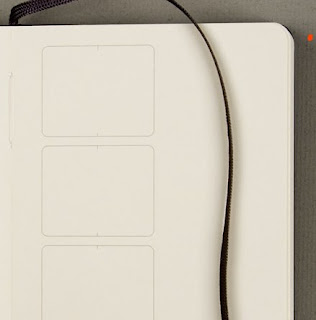
Unfortunately, they don't make them bigger, however I did find a template guide to create your own pages in a bigger moleskine...Moleskine Hack: Turn a Large Sketchbook into a Storyboard Notebook on Ninth Wave Designs' page.
I also just recently found "Comic Life", the software comic template/layout program by plasq...Add effects to photos or files, some balloons and you have a fresh new comic from start to finish in no time flat. Your iPhoto library and hard drive files are always at your fingertip - just drag in your pictures. Drag on some captions, 'sound effect' text (‘ka-blam!') and speech bubbles and your work is done! An interesting program called "Skitch" is also available by invite only to the Beta version...
P.S. For those who dabble in audio...I am having a lot of fun playing with DJay...It's a great program...a bit slow on the importing of the song to the table...but man, the hours of entertainment...
Storyboard Oasis Pads feature boxes for sketching ideas or objectives, and rules for itemizing their message points or action items.
C has a Moleskine storyboard pocket Notebook...

| Item #: | KLMB802 |
| Size: | 3.5 x 5.5" (9 x 14 cm) |
| Pages: | 80 pages of top-quality paper -- 40 pages with 2 frames, 40 pages with 4 frames |
| List Price: | $11.00 |
| Our Price: | $9.95 at moleskines.com |
Unfortunately, they don't make them bigger, however I did find a template guide to create your own pages in a bigger moleskine...Moleskine Hack: Turn a Large Sketchbook into a Storyboard Notebook on Ninth Wave Designs' page.
I also just recently found "Comic Life", the software comic template/layout program by plasq...Add effects to photos or files, some balloons and you have a fresh new comic from start to finish in no time flat. Your iPhoto library and hard drive files are always at your fingertip - just drag in your pictures. Drag on some captions, 'sound effect' text (‘ka-blam!') and speech bubbles and your work is done! An interesting program called "Skitch" is also available by invite only to the Beta version...
P.S. For those who dabble in audio...I am having a lot of fun playing with DJay...It's a great program...a bit slow on the importing of the song to the table...but man, the hours of entertainment...
Action Figure Sites of Interest...
You can build your own custom "urban crew" though I thought it covered only a specific stereotype of "urban"...Very limited in choice of heads, I thought, they need more and some of the outfits need a little more realism...but it definitely is worth the time to check out their site....www.herobuilders.com
They have great political action figures and wierd pop culture stuff, too...The villain figures are amazing...
Also, Enterbay has a really well-designed site, clean and simple, and I love the precision they use to create and think through all the details in their craftsmanship...

They have great political action figures and wierd pop culture stuff, too...The villain figures are amazing...
Also, Enterbay has a really well-designed site, clean and simple, and I love the precision they use to create and think through all the details in their craftsmanship...
Tuesday, July 24, 2007

the iPhone: a review by David Pogue...
The iPhone Matches Most of Its Hype
The iPhone, set to be released on June 29, is three devices in one: a cellphone, a wide-screen iPod, and an Internet communications device.
Talk about hype. In the last six months, Apple’s iPhone has been the subject of 11,000 print articles, and it turns up about 69 million hits on Google. Cultists are camping out in front of Apple stores; bloggers call it the “Jesus phone.” All of this before a single consumer has even touched the thing.
So how is it?As it turns out, much of the hype and some of the criticisms are justified. The iPhone is revolutionary; it’s flawed. It’s substance; it’s style. It does things no phone has ever done before; it lacks features found even on the most basic phones.
Unless you’ve been in a sensory-deprivation tank for six months, you already know what the iPhone is: a tiny, gorgeous hand-held computer whose screen is a slab of touch-sensitive glass.
The $500 and $600 models have 4 and 8 gigabytes of storage, respectively — room for about 825 or 1,825 songs. (In each case, 700 megabytes is occupied by the phone’s software.) That’s a lot of money; then again, the price includes a cellphone, video iPod, e-mail terminal, Web browser, camera, alarm clock, Palm-type organizer and one heck of a status symbol.
The phone is so sleek and thin, it makes Treos and BlackBerrys look obese. The glass gets smudgy — a sleeve wipes it clean — but it doesn’t scratch easily. I’ve walked around with an iPhone in my pocket for two weeks, naked and unprotected (the iPhone, that is, not me), and there’s not a mark on it.
But the bigger achievement is the software. It’s fast, beautiful, menu-free, and dead simple to operate. You can’t get lost, because the solitary physical button below the screen always opens the Home page, arrayed with icons for the iPhone’s 16 functions.
You’ve probably seen Apple’s ads, showing how things on the screen have a physics all their own. Lists scroll with a flick of your finger, CD covers flip over as you flick them, e-mail messages collapse down into a trash can. Sure, it’s eye candy. But it makes the phone fun to use, which is not something you can say about most cellphones.
Apple has chosen AT&T (formerly Cingular) to be the iPhone’s exclusive carrier for the next few years, in part because the company gave Apple carte blanche to revise everything people hate about cellphones.
For example, once the phone goes on sale this Friday, you won’t sign up for service in a phone store, under pressure from the sales staff. You will be able to peruse and choose a plan at your leisure, in the iTunes software on your computer. Better yet, unlimited Internet service adds only $20 a month to AT&T’s voice-plan prices, about half what BlackBerry and Treo owners pay. For example, $60 gets you 450 talk minutes, 200 text messages and unlimited Internet; $80 doubles that talk time. The iPhone requires one of these voice-and-Internet plans and a two-year commitment.
On the iPhone, you don’t check your voice mail; it checks you. One button press reveals your waiting messages, listed like e-mail. There’s no dialing in, no password — and no sleepy robot intoning, “You...have...twenty...one...messages.”
To answer a call, you can tap Answer on the screen, or pinch the microscopic microphone bulge on the white earbud cord. Either way, music or video playback pauses until you hang up. (When you’re listening to music, that pinch pauses the song. A double-pinch advances to the next song.)
Making a call, though, can take as many as six steps: wake the phone, unlock its buttons, summon the Home screen, open the Phone program, view the Recent Calls or speed-dial list, and select a name. Call quality is only average, and depends on the strength of your AT&T signal.
E-mail is fantastic. Incoming messages are fully formatted, complete with graphics; you can even open (but not edit) Word, Excel and PDF documents.
The Web browser, though, is the real dazzler. This isn’t some stripped-down, claustrophobic My First Cellphone Browser; you get full Web layouts, fonts and all, shrunk to fit the screen. You scroll with a fingertip — much faster than scroll bars. You can double-tap to enlarge a block of text for reading, or rotate the screen 90 degrees, which rotates and magnifies the image to fill the wider view.
Finally, you can enlarge a Web page — or an e-mail message, or a photo — by spreading your thumb and forefinger on the glass. The image grows as though it’s on a sheet of latex.
The iPhone is also an iPod. When in its U.S.B. charging cradle, the iPhone slurps in music, videos and photos from your Mac or Windows PC. Photos, movies and even YouTube videos look spectacular on the bright 3.5-inch very-high-resolution screen.
The Google Maps module lets you view street maps or aerial photos for any address. It can provide driving directions, too. It’s not real G.P.S. — the iPhone doesn’t actually know where you are — so you tap the screen when you’re ready for the next driving instruction.
But how’s this for a consolation prize? Free live traffic reporting, indicated by color-coded roads on the map.
Apple says one battery charge is enough for 8 hours of calls, 7 hours of video or 24 hours of audio. My results weren’t quite as impressive: I got 5 hours of video and 23 hours of audio, probably because I didn’t turn off the phone, Wi-Fi and other features, as Apple did in its tests. In practice, you’ll probably wind up recharging about every other day.
So yes, the iPhone is amazing. But no, it’s not perfect.
There’s no memory-card slot, no chat program, no voice dialing. You can’t install new programs from anyone but Apple; other companies can create only iPhone-tailored mini-programs on the Web. The browser can’t handle Java or Flash, which deprives you of millions of Web videos.
The two-megapixel camera takes great photos, provided the subject is motionless and well lighted . But it can’t capture video. And you can’t send picture messages (called MMS) to other cellphones.
Apple says that the battery starts to lose capacity after 300 or 400 charges. Eventually, you’ll have to send the phone to Apple for battery replacement, much as you do now with an iPod, for a fee.
Then there’s the small matter of typing. Tapping the skinny little virtual keys on the screen is frustrating, especially at first.
Two things make the job tolerable. First, some very smart software offers to complete words for you, and, when you tap the wrong letter, figures out what word you intended. In both cases, tapping the Space bar accepts its suggestion.
Second, the instructional leaflet encourages you to “trust” the keyboard (or, as a product manager jokingly put it, to “use the Force”). It sounds like new-age baloney, but it works; once you stop stressing about each individual letter and just plow ahead, speed and accuracy pick up considerably.
Even so, text entry is not the iPhone’s strong suit. The BlackBerry won’t be going away anytime soon.
The bigger problem is the AT&T network. In a Consumer Reports study, AT&T’s signal ranked either last or second to last in 19 out of 20 major cities. My tests in five states bear this out. If Verizon’s slogan is, “Can you hear me now?” AT&T’s should be, “I’m losing you.”
Then there’s the Internet problem. When you’re in a Wi-Fi hot spot, going online is fast and satisfying.
But otherwise, you have to use AT&T’s ancient EDGE cellular network, which is excruciatingly slow. The New York Times’s home page takes 55 seconds to appear; Amazon.com, 100 seconds; Yahoo. two minutes. You almost ache for a dial-up modem.
These drawbacks may be deal-killers for some people. On the other hand, both the iPhone and its network will improve. Apple points out that unlike other cellphones, this one can and will be enhanced with free software updates. That’s good, because I encountered a couple of tiny bugs and one freeze. (There’s also a tantalizing empty space for a row of new icons on the Home screen.) A future iPhone model will be able to exploit AT&T’s newer, much faster data network, which is now available in 160 cities.
But even in version 1.0, the iPhone is still the most sophisticated, outlook-changing piece of electronics to come along in years. It does so many things so well, and so pleasurably, that you tend to forgive its foibles.
In other words, maybe all the iPhone hype isn’t hype at all. As the ball player Dizzy Dean once said, “It ain’t bragging if you done it.”
The Sizes of Infinity...
Strange but True: Infinity Comes in Different Sizes
If you were counting on infinity being absolute, your number's up
By John Matson from Sciam.com
Take, for instance, the so-called natural numbers: 1, 2, 3 and so on. These numbers are unbounded, and so the collection, or set, of all the natural numbers is infinite in size. But just how infinite is it? Cantor used an elegant argument to show that the naturals, although infinitely numerous, are actually less numerous than another common family of numbers, the "reals." (This set comprises all numbers that can be represented as a decimal, even if that decimal representation is infinite in length. Hence, 27 is a real number, as is π, or 3.14159….) "The idea of being 'larger than' was really a breakthrough," says Stanley Burris, professor emeritus of mathematics at the University of Waterloo in Ontario. "You had this basic arithmetic of infinity, but no one had thought of classifying within infinity—it was just kind of a single object before that."Adds mathematician Joseph Mileti of Dartmouth College: "When I first heard the result and first saw it, it was definitely something that knocked me over. It's one of those results that's short and sweet and really, really surprising."
In the 1995 Pixar film Toy Story, the gung ho space action figure Buzz Lightyear tirelessly incants his catchphrase: "To infinity … and beyond!" The joke, of course, is rooted in the perfectly reasonable assumption that infinity is the unsurpassable absolute—that there is no beyond.
That assumption, however, is not entirely sound. As German mathematician Georg Cantor demonstrated in the late 19th century, there exists a variety of infinities—and some are simply larger than others.
In fact, Cantor showed, there are more real numbers packed in between zero and one than there are numbers in the entire range of naturals. He did this by contradiction, logically: He assumes that these infinite sets are the same size, then follows a series of logical steps to find a flaw that undermines that assumption. He reasons that the naturals and this zero-to-one subset of the reals having equally many members implies that the two sets can be put into a one-to-one correspondence. That is, the two sets can be paired so that every element in each set has one—and only one—"partner" in the other set.
Think of it this way: even in the absence of numerical counting, one-to-one correspondences can be used to measure relative sizes. Imagine two crates of unknown sizes, one of apples and one of oranges. Withdrawing one apple and one orange at a time thus partners the two sets into apple-orange pairs. If the contents of the two crates are emptied simultaneously, they are equally numerous; if one crate is exhausted before the other, the one with remaining fruit is more plentiful.
Cantor thus assumes that the naturals and the reals from zero to one have been put into such a correspondence. Every natural number n thus has a real partner rn. The reals can then be listed in order of their corresponding naturals: r1, r2, r3, and so on.
Then Cantor's wily side begins to show. He creates a real number, called p, by the following rule: make the digit n places after the decimal point in p something other than the digit in that same decimal place in rn. A simple binary method would be: choose 0 when the digit in question is 1; otherwise, choose 1.
For demonstration's sake, say the real number pair for the natural number 1 (r1) is the decimal component of π (0.14159…), the pair for 2 (r2) is George W. Bush's share of the popular vote in 2000 (0.47868…) and that of 3 (r3) is Ted Williams's famed .400 batting average from 1941 (0.40570…).
Now create p following Cantor's construction: the digit in the first decimal place should not be equal to that in the first decimal place of r1, which is 1. Therefore, choose 0, and p begins 0.0…. Then choose the digit in the second decimal place of p so that it does not equal that of the second decimal place of r2, which is 7 (choose 1; p = 0.01…). Finally, choose the digit in the third decimal place of p so that it does not equal that of the corresponding decimal place of r3, which is 5 (choose 1 again; p = 0.011…).
Continuing down the list, this mathematical method (called "diagonalization") generates a real number p between zero and one that, by its construction, differs from every real number on the list in at least one decimal place. Ergo, it cannot be on the list.
In other words, p is a real number without a natural number partner—an apple without an orange. Thus, the one-to-one correspondence between the reals and the naturals fails, as there are simply too many reals—they are "uncountably" numerous—making real infinity somehow larger than natural infinity.
Harry magic for Amazon...

Aided by Harry Potter Fans, Amazon Triples Its Profit
SAN FRANCISCO, July 24 — Some of Harry Potter’s magic has rubbed off on Amazon.com. The company, based in Seattle, announced today that its second-quarter net income increased more than threefold on revenue that rose 35 percent.
The news pushed up the company’s stock in after-hours trading to a level it has not reached since February 2000, during the heyday of the dot-com boom.
The results come four days after Amazon delivered 2.2 million copies of “Harry Potter and the Deathly Hallows,” the final installment in the blockbuster fantasy series. Amazon will count that revenue next quarter, but interest in the book helped drive 8 percent more traffic to the site in the most recent quarter, according to Nielsen/NetRatings. Other purchases that Potter fans tacked on counted toward Amazon’s quarter, which ended June 30.
The online retailer reported net income of $78 million, or 19 cents a share, compared with $22 million, or 5 cents a diluted share, in the same period last year.
Adidas hopping bad...
California bars Adidas from selling kangaroo shoes
By Alexandria Sage Tue Jul 24, 12:25 PM ET from Yahoo.com
LOS ANGELES (Reuters) - The Supreme Court of California Monday barred athletic shoe maker Adidas from selling shoes made from kangaroo leather in California, reversing a lower court's decision.
California does not allow products made from kangaroos to be sold or imported into the state, but Adidas had claimed that the state law conflicted with the aims of the U.S. Endangered Species Act, which sought to support Australian efforts to control kangaroos. The expanding population of the jumping marsupials has become a problem for Australia."The bottom line is they've decided the California law is constitutional. As of now, it is illegal to sell products made of kangaroos in California," said Orly Degani, a lawyer for Viva! USA, an animal rights group that first filed a lawsuit in 2003 challenging the sale of kangaroo-skin shoes in the state.
A lawyer for the Humane Society of the United States, which filed a "friend of the court" brief on behalf of plaintiffs Viva! USA, called the court's decision "critically important" for species other than just kangaroos -- such as grizzly bears, bald eagles and wolves, which are dependent on state protection.
"When the federal government decides not to protect a species, the state can still do so," said HSUS counsel Jonathan Lovvorn, explaining the ruling. "What Adidas was saying was when the federal government decides not to protect a species, the state can't protect it either. That was squarely rejected by the court."
A spokeswoman for Adidas wrote in an e-mail that the company expects to ultimately prevail in the matter, but did not clarify further. Other legal matters related to the case now will be sent back to the appeals court.
Meanwhile, a bill that would overturn California's ban is working its way through the state legislature.
"Although Adidas makes some shoes using kangaroo leather, a common practice in our industry, Adidas does not make shoes from any endangered or threatened kangaroo species," said the Adidas spokeswoman Andrea Corso.
The Supreme Court's decision reversed a victory for defendants Adidas and retailers Sports Chalet and Offside Soccer last year when they won their appeal of the lawsuit brought by Viva! USA.
NY...Arts back in schools?
Bloomberg Announces Plan to Shore Up Arts in Schools
By Jennifer Median from NYTimes.comPublished: July 24, 2007
Mayor Michael R. Bloomberg announced yesterday that the city’s Department of Education will require all schools to maintain arts programs, and that principals will be rated in their annual reviews on how well they run those programs.
The announcement came just months after the department infuriated arts groups by eliminating a multimillion-dollar program to finance arts education.
Under a new set of city standards, the arts curriculums will be judged for comprehensiveness, and potential pay bonuses for principals could be affected.
“An excellent arts education is essential,” the mayor said at a news conference at Stuyvesant High School in Manhattan.
Last winter, the city schools chancellor, Joel I. Klein, told several arts advocates that the department was planning to give principals discretion over $67.5 million that had previously been budgeted specifically for Project Arts, which financed arts education. The project, developed in the Giuliani administration, was intended to rebuild arts programs that were obliterated during the fiscal crisis of the 1970s.
Yesterday’s announcement was met with muted praise and skepticism from arts advocates, who have worried that if no money is targeted for the arts, principals in struggling schools will eliminate arts programs to devote more money to basic reading and math programs.
The Project Arts money was used to pay for a variety of things: supplies, teachers, dance and music instruction, artist residencies. Officials said the money was a fraction of the department’s spending on arts. The change in arts financing is part of a larger effort by the administration to give principals more control over how money is spent in their schools. But even as they give principals more authority over how to run their schools, officials are demanding that principals who do not meet requirements in math and reading — and now the arts — face being reassigned.
“I think experience has shown us that money alone will not improve student outcomes in the arts or any other subject,” the mayor said. “Money doesn’t make the difference, accountability does.”
...Under the new plan, arts will be part of the revamped school report cards to be issued starting this fall. The arts will be one factor used to judge a school’s “learning environment,” which will make up 15 percent of a school’s grade. A school will also receive an annual review of its program that will be used to determine whether the principal gets a performance bonus.
The department will also begin issuing an annual report in January about the arts programs in each school. That report will be developed partly by a newly formed arts education task force, which is made up of several leaders from arts groups around the city.
Richard Kessler, the executive director of the Center for Arts Education, which had been the most vocal critic of the plan to divert the money from Project Arts, said yesterday that his group would take a wait-and-see approach. “We applaud the public commitment of the mayor and chancellor that every single school will meet state requirements,” he said, “and that they will be holding every single principal accountable to meeting the state requirements.”
Chancellor Klein said the city was not backing off a commitment to reinvigorate arts programs. He has repeatedly acknowledged that the school system has a wide mix of programs that range from stellar to nonexistent. A few years ago, he introduced a “blueprint” for arts education. “I didn’t want the arts to be a throwaway, I didn’t want arts be some add-on, some feel-good thing,” Mr. Klein said yesterday. “Arts education is critical, but it’s got to be coherent.”
Monday, July 23, 2007
Sunday, July 22, 2007
The Summer Jump Off
Last night C and I traveled to the LES ...
and attended the FlyID crew's show at Crudo...
Great canvasses and good to meet some new faces, hang out with Dil and MTK76...Especially nice to meet Yes and Mes...
and attended the FlyID crew's show at Crudo...
Great canvasses and good to meet some new faces, hang out with Dil and MTK76...Especially nice to meet Yes and Mes...
Tuesday, July 10, 2007
The Next to the Last of the Single Homegirls...
Alexandra and Bertie got married in Cali last month...It was beautiful...The bachelorette party was a blast too...Best wishes for a happy and fruitful marriage...Adrian is so cute!!


Friday, June 01, 2007

Subscribe to:
Posts (Atom)
